
Finding the mirror line
Reflections as number lines
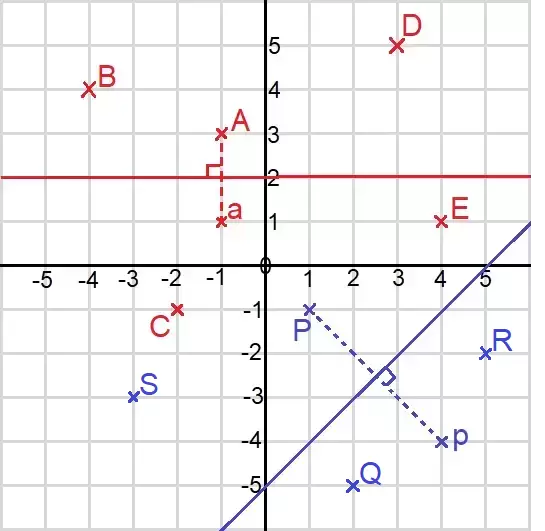
I have drawn two lines on the graph on the left. Both of these lines are going to act like mirrors and any point on the graph will have a reflection in those mirrors. Let's look at the red mirror to start with (ignore the blue one for the time being). The equation of this line is y = 2 (see a little later on), but that equation isn't relevant for this part of the tutorial.
Point A, at (-1,3), is a person standing in front of the mirror. He can see his reflection behind the mirror. To work out where the reflected image is, you draw a line from point A that is perpendicular to the mirror. This means that the line that you draw must be at 90o to the mirror. You'll see that I've marked that dotted red line with a small square on it.
Continue this line beyond the mirror for the same distance that A is in front of the mirror, and that's where the image is. In this case, point A is 1 unit in front of the mirror, so its mirror image, which I've marked a is one unit behind it. The reflection of A is at (-1,1).
Where are the reflections of the following points in the red line mirror? Remember, for each one, move directly the to mirror at right-angles to it, and then continue for the same distance behind the mirror. Most of them you will be able to trace on the graph, but some of them will go off the graph paper. You can still work out the answer, though:
Now we will park the red mirror line and look at the blue one. This is a diagonal mirror (with the equation y = x - 5, but you don't need to know that). However the principle still applies. This time you have to trace distance to the mirror as a diagonal line as well, since it must always be at right angles to the mirror. Look at point P. This is a distance of one and a half "diagonal units" in front of the mirror, so its image must be one and a half diagonal units behind the mirror as well, which is point p.
Please find the co-ordinates of the following points when reflected in the blue mirror. Some of them will be on the graph itself, but the others go off the edge. You can still work them out, though, just by imagining the graph in your head or working it out on paper:
 As you can see, reflection on a graph has a lot in common with reflection in the real world, but there are limits to how far you can take the analogy. For instance, in mathematical reflection, an object can have a reflection in a mirror line, even if it overlaps that mirror line (which doesn't happen in the real world).
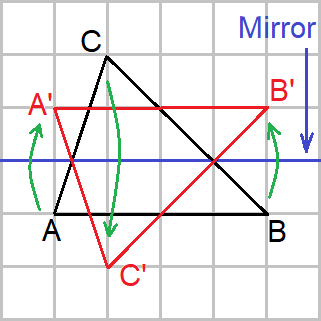
For instance, look at the object on the right. It is being reflected in mirror line, but the object itself straddles the mirror line itself. Points A and B are below the mirror, so their reflections (marked A' and B') are above the mirror. However, point C is above the mirror, so its reflection, C', is below it. As expected, the arrow now points in the opposite direction, as you would expect.
Points that are actually on the mirror line are the only points that don't move when they are reflected. This matches real life: If you were to get so close to a mirror that your nose was touching it, the reflection of the tip of your nose would be touching your real nose, i.e. they would be at the same place on the mirror glass itself.
Computers use graphical operations such as reflection and rotation to alter the appearance of objects on the screen. This is typically done in video games to move objects around the screen. The ability to describe a reflection (or a rotation, or whatever) in terms of mathematical steps is therefore very useful.
You might well be asked to do the same thing, but only for very simple reflections in a horizontal or vertical line. It's particularly easy if you are reflecting in one of the axes:
Reflecting in the x-axis (y = 0):
Reflecting in the y-axis (x = 0):
It's also fairly easy to reflect a point mathematically in the diagonal line y = x. In this case, you simply swap the x and y co-ordinates.
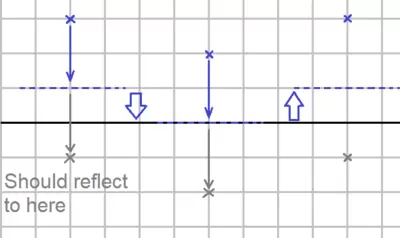 The problem comes when you want to reflect a point about a horizontal mirror line that isn't the x-axis. You can't just reverse the sign on the y co-ordinate. However, that's the only mathematical way we have of reflecting in a horizontal line. Fortunately, the task is do-able providing we do one extra step beforehand and one extra step afterwards. I have broken the problem down into three stages, as shown on the right:
What we do is shift the mirror line until it is the x-axis, then reflect the point and then shift the mirror line back to its initial position, taking the reflected point with it. The diagram shows the point (x,3) in the horizontal line y = 1. I haven't specified the value of x, as it is irrelevant to the calculation.
This gives us a simple formula for reflecting a point in any horizontal line. For instance, if you wanted to reflect the point (14,13) in the line y = -2, and we did in on a grid of squared paper, we would see that the reflected point would be (14,-17), which is 15 units below the mirror line, just as (14,13) is 15 units above it. If we put 13 in the 2M-y formula, we do indeed get 2 x (-2) - 13 = -17. Similarly, if we reflect the point (-2.5,-10.1) using y = 3, the graph would tell us that the reflected point was (-2.5,16.1). The formula gives us 2 x 3 - (-10.1) = 6 + 10.1 = 16.1. It does work.
Using similar logic, and a three-step process, we can come up with a similar formula for reflecting a point (x,y) in a vertical line with the equation x = N. In this case, the y co-ordinate stays the same, but the x co-ordinate is replaced by 2N-x.