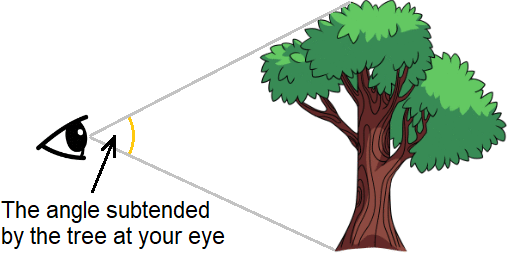
In circle theorems, you'll meet this word subtended quite a lot. It refers to an angle that is formed by its relation to a line. Take a look at that tree on the left. Someone looks at the top of the tree, then rotates his eyeball down to look at the bottom. The angle that is formed is subtended by the tree. In general, any line (curved, straight or wiggly) subtends an angle at some distant point (not on the line). You start at one end of the line, move directly towards the point and "bounce off" it directly to the other end of the line.
Here is the first circle theorem that you'll meet, and it uses the word "subtended" twice.
The angle subtended by any arc of a circle at the centre of the circle is twice the angle the same arc subtends anywhere on the circumference.
Take a look at the diagram on the right. You can see a circle with the centre point marked as O. As a general rule, when you need to label the points on or in a circle, the centre point is always marked O. There is an arc of the circle (a piece of the circumference) marked PQ in orange. It's the minor arc (which means we take the short way round from P to Q, not the long way), but the same theorem applies to the major arc (over the top of the circle, in this case) as we will see later.
The minor arc PQ subtends (there's the magic word!) an angle at the centre shown in yellow. It also subtends an angle at some arbitrary point on the circumference (shown in green), on the far side of the centre. I haven't chosen any particular spot on the circumference - any point will do. The theorem states that the yellow angle must be twice as big as the green angle.
The diagram on the left shows another example of the same thing, except that in this case, I have pushed the angle subtended by DE at circumference so far over to the right that the lines cross over each other. It makes no difference: The angle subtended by DE at the centre (marked a here) is still twice as large as the angle subtended at the circumference (b here).
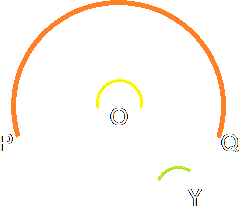
The diagram on the right on the other hand goes back to the original arc, PQ, but this time considers the major arc, i.e. the longer of the two possible arcs, marked in orange. The theorem still applies, but this time the green angle subtended at the circumference is an obtuse one (larger than 90o). The yellow angle subtended at the centre is now a reflex one (larger than 180o), but is still exactly twice the size of the green one.
Proving it...
Curiously, this theorem is the only one that is ever generally proved. Maybe it's because just about every other circle theorem (until you get to tangents, that is) is based on it in some way. Still, your class might be asked to prove it, and you will be able to step up and say to the teacher "Well, I don't mind doing it, if you don't feel up to the job..."
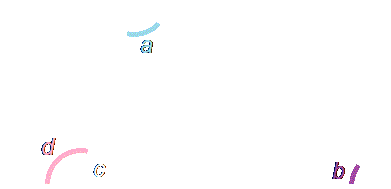
I've put a triangle on the left, as we will need to refer to this lesser theorem during our proof. You will remember that the angles in a triangle add up to 180o. Angles forming a straight line also add up to 180o. The angles are marked with letters, so a + b + c = 180o and d + c = 180o. Putting these two together tells us that d = a + b. This is a standard triangle theorem: Any exterior angle of a triangle is equal to the sum of the two opposite interior angles. Just bear that in mind...
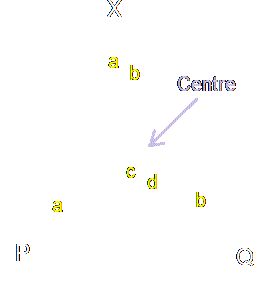
Take a look at the diagram on the right. I would normally mark the centre as O, but it's a little crowded at the centre of that picture, so just assume that the point indicated by the arrow is the centre of the circle and that I've labelled it O.
The three lines OP, OQ and OX are all the same length because they are all radii of the circle. You'll see that I have marked them all the same length with a dash on each of them. This forms two triangles that are isosceles as they each have two sides that are the same length: POX and QOX both have two sides that are equal to the radius of the circle.
You know that isosceles triangles always have two angles the same, and that, for any isosceles triangle, the two identical angles are opposite the two identical sides. In triangle POX, I have marked the two identical angles a and in triangle QOX, they are marked b. Take a good, hard look at that diagram to satisfy yourself that the marked angles are indeed the same as each other.
This is where we go back to that triangle theorem. I have extended the radius OX beyond the centre so that two exterior angles are formed. The angle c is the exterior angle for the triangle with the two a angles, and angle d is the exterior angle for the triangle with the two b angles. From the triangle theorem, we know that angle c is the sum of the two interior opposite angles, i.e. a + a = 2a, which gives us c = 2a. Similarly, angle d must be the sum of the two interior opposite angles, i.e. b + b = 2b, which gives us d = 2b
The angle subtended by the minor arc PQ at the circumference is PXQ, which is equal to a + b. The angle subtended by the same arc at the centre is POQ, which is equal to c + d = 2a + 2b = 2(a + b). This means that the angle subtended at the centre must be twice the angle subtended at the circumference. This theorem only works because the distance from the centre of a circle to any point on the circumference is always the same.
Proving the reflex angle case is done in very much the same way. Again we extend the radius from Y to O a bit further to form two more exterior angles, c and d. Again, there are now three lines which are all equal to the radius of the circle, PO, YO and QO, forming two isosceles triangles. The two interior opposite angles, both a, add up to give c. The two interior opposite angles, both b, add up to give d. The angle subtended at the centre come to c + d, the angle at the circumference to a + b. c + d = 2a + 2b = 2(a + b), so again, the angle subtended at the centre is twice the size of the angle subtended at the circumference.
The other case is the one where the lines cross over each other. The minor arc DE subtends an angle of a (angle DME) at the circumference and b (angle DOE) at the circumference. This proof is a little more involved, and we have to add an extra line from O to M. The lines OM, OE and OD are all radii of the circle, and are all the same length.
The triangle ODM is isosceles, so both the angles D and OMD are both equal. I've called that angle x. If we call the missing angle of that triangle, ODM, c, then we can add up all the angles of that triangle to make 180o:
x + x + b + c = 180o b = 180 - c - 2x
The other isosceles triangle is OME, with sides OM and OE the same. The two angles that are the same are OEM and OME. Since OME = x + a, then OEM must be x + a as well.
The third angle of triangle OME is the angle we called c, and the three angles of that triangle add up to the standard 180o.
(x + a) + (x + a) + c = 180o 2x + 2a + c = 180o 2a = 180o - c - 2x
Now we have two equations that are almost identical. Comparing the two shows us that b is the same as 2a. In other words, the angle subtended by DE at the centre (b) is twice as large as the angle subtended at the circumference (a). It's a more roundabout journey, but we got there in the end.
The other theorems
Some mathematicians refer to these as "daughter theorems" as they all rely very heavily on the theorem you've just seen. Here's the first one:
An arc of a circle always subtends the same angle anywhere on the circumference.
This one follows on naturally from what you've seen above, so much so that it doesn't really need proving. In the diagram you see the arc of the circle and I have marked angles subtended at the circumference in several places. These angles must all be equal, as they are all exactly half of the angle that that arc subtends at the circumference, so I have marked them all in green.
The same thing applies if you consider the major arc, except all these angles would be obtuse and they would all be in the lower half of the diagram. I haven't bothered to draw that case out - you just have to imagine it.
A diameter of a circle always subtends a right-angle at the circumference.
You might hear this quoted as "a semicircle always subtends a right-angle at the circumference", which is the same thing. Either way, the diameter goes straight through the centre of the circle. This means that the angle subtended at the centre is a straight line, i.e. 180o, which in turn means that the angle subtended by the diameter at the circumference must be half of that - a right-angle, 90o.
The opposite angles of a cyclic quadrilateral always add up to 180o
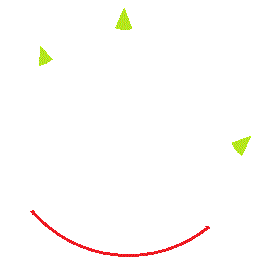
No, a cyclic quadrilateral isn't one that can read your mind and levitate objects. That's a psychic quadrilateral, and they don't exist anyway. A cyclic quadrilateral is a four-sided figure where all four of the vertices lie on the circumference of the same circle, like PQRS in the diagram on the right.
The minor arc SQ (through R) subtends an angle a at point P on the circumference, so it must subtend an angle twice as large, 2a, at the centre, as shown. Similarly, the major arc SQ (through P) subtends an angle b at point R on the circumference, so it must subtend an angle twice as large, 2b, at the centre.
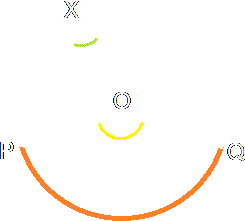 Take a look at the diagram on the right. You can see a circle with the centre point marked as O. As a general rule, when you need to label the points on or in a circle, the centre point is always marked O. There is an arc of the circle (a piece of the circumference) marked PQ in orange. It's the minor arc (which means we take the short way round from P to Q, not the long way), but the same theorem applies to the major arc (over the top of the circle, in this case) as we will see later.
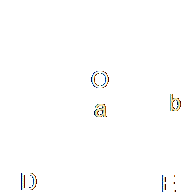
 The diagram on the left shows another example of the same thing, except that in this case, I have pushed the angle subtended by DE at circumference so far over to the right that the lines cross over each other. It makes no difference: The angle subtended by DE at the centre (marked a here) is still twice as large as the angle subtended at the circumference (b here).
 Curiously, this theorem is the only one that is ever generally proved. Maybe it's because just about every other circle theorem (until you get to tangents, that is) is based on it in some way. Still, your class might be asked to prove it, and you will be able to step up and say to the teacher "Well, I don't mind doing it, if you don't feel up to the job..."
 Take a look at the diagram on the right. I would normally mark the centre as O, but it's a little crowded at the centre of that picture, so just assume that the point indicated by the arrow is the centre of the circle and that I've labelled it O.
 Proving the reflex angle case is done in very much the same way. Again we extend the radius from Y to O a bit further to form two more exterior angles, c and d. Again, there are now three lines which are all equal to the radius of the circle, PO, YO and QO, forming two isosceles triangles. The two interior opposite angles, both a, add up to give c. The two interior opposite angles, both b, add up to give d. The angle subtended at the centre come to c + d, the angle at the circumference to a + b. c + d = 2a + 2b = 2(a + b), so again, the angle subtended at the centre is twice the size of the angle subtended at the circumference.
 The other case is the one where the lines cross over each other. The minor arc DE subtends an angle of a (angle DME) at the circumference and b (angle DOE) at the circumference. This proof is a little more involved, and we have to add an extra line from O to M. The lines OM, OE and OD are all radii of the circle, and are all the same length.

 No, a cyclic quadrilateral isn't one that can read your mind and levitate objects. That's a psychic quadrilateral, and they don't exist anyway. A cyclic quadrilateral is a four-sided figure where all four of the vertices lie on the circumference of the same circle, like PQRS in the diagram on the right.