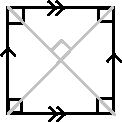
Square
- All the sides the same length.
- All the angles are 90o (right angles).
- Opposite sides are parallel.
- The diagonals are the same length and cross at 90o.
- Find the area by squaring the side length.
- Find the length of the diagonal using Pythagoras.
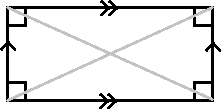
Rectangle
- Opposite sides are the same length and parallel.
- All the angles are 90o.
- Find the area by multiplying length by width.
- The diagonals are the same length but don't cross at 90o.
- Find the length of the diagonal using Pythagoras.
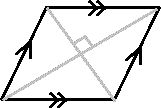
Rhombus
- All the sides the same length.
- Opposite angles are equal.
- Opposite sides are parallel.
- The diagonals cross at 90o.
- A rhombus is essentially a square "pushed sideways".
Parallelogram
- Opposite sides are the same length and parallel.
- The angles aren't 90o
- Opposite angles are equal.
- Find the area by multiplying length by vertical height.
- A parallelogram is essentially a rectangle "pushed sideways".
(Note the spelling: parallel followed by -ogram)
Trapezium
- Only one pair of parallel sides.
- Doesn't have to be symmetrical.
- Find the area by multiplying average of parallel sides by the vertical distance between them.

Kite
- Two pairs of sides that are equal, but the sides are next to one another (adjacent), as shown by the dashes and double dashes.
- One line of symmetry, down the longer diagonal.
- The diagonals cross at 90o.
- You can calculate the area by splitting the kite into two identical triangles.
Arrowhead
- The only quadrilateral with a reflex angle (> 180o) as one of the interior angles.
- One line of symmetry along the diagonal that is inside the arrowhead. The other diagonal is outside.
Scalene
- No sides the same length.
- No angles the same size.
- Basically, anything that doesn't fall into any of the above categories.